 Shipping Canada-Wide
 USA Store




The Real Truth About Flooring Sound Ratings: Why Delta IIC Matters More Than “IIC 70+”
If you have been shopping for flooring for a condominium or apartment, you have probably seen advertisements claiming “IIC 70+” or “STC 70+.” These numbers sound impressive, and many condo boards now ask for them before approving a new floor.
Unfortunately, these numbers are often misunderstood.
A floor that claims an IIC of 70 may not actually be quieter than another floor that honestly measures in the 50–60 range.
The reason is simple: most of the large advertised numbers come from the building structure—not from the flooring itself.
Why Many “IIC 70+” Floors Still Create Noise Problems
Across North America, many condos have approved laminate or vinyl flooring installed over thin foam underlay because the packaging claimed a very high sound rating.
Yet those same buildings often continue to receive complaints about:
- Footsteps from upstairs
- Chairs scraping across the floor
- Children running
- Items being dropped
- Noise transferring into neighbouring suites
Why does this happen?
Because thin foam underlays are often tested under ideal laboratory conditions using:
- Very thick concrete slabs
- Suspended ceilings below
- Acoustic insulation inside the ceiling cavity
- Extra air space
The entire assembly may produce a number above IIC 70.
However, the flooring and foam underlay alone may only be contributing 3–10 dB of real sound reduction.
That is why so many floors with “big” sound ratings still perform poorly in actual homes.
The Most Important Number Is Delta IIC
Instead of looking only at the final IIC number, you should look at Delta IIC.
Delta IIC measures only the sound reduction created by the flooring and underlay.
It removes the contribution of the concrete slab and the rest of the building structure.
This makes Delta IIC the most honest way to compare one floor to another.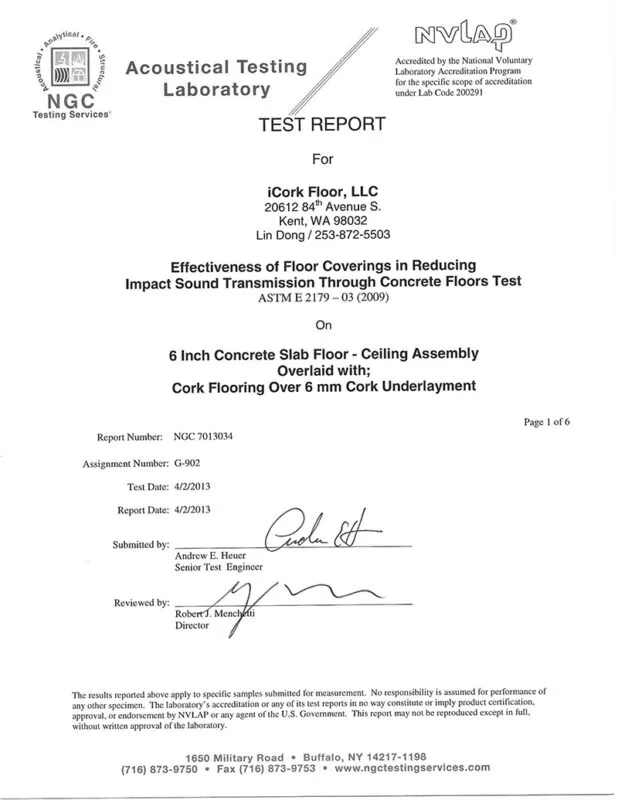
How Delta IIC Is Tested
The Delta IIC test uses only:
- A standard 6-inch concrete slab
- The underlay
- The flooring installed on top
The sound rating of the concrete slab is then subtracted from the result.
The remaining number shows how much sound reduction the flooring system truly adds.
What Is a Good Delta IIC?
| Delta IIC | Real-World Performance |
|---|---|
| 3–10 dB | Small improvement |
| 14 dB | Good |
| 20 dB | Excellent |
| 24+ dB | Outstanding |
In the flooring industry, a Delta IIC of 14 is considered a good acoustic floor.
A real Delta IIC of 20 or more is considered excellent.
Our Original Test Results
Our original acoustical testing used:
- 11 mm cork floating floor
- 6 mm cork underlay
The 11 mm floor contained approximately 4 mm of real cork inside the plank.
That flooring system achieved a Delta IIC of 20 dB when tested over a standard 6-inch concrete slab. According to the test report, the increase in impact insulation class was 20.0 dB. fileciteturn2file0
That is already considered an excellent result.
Why Our New 12 mm Cork Floor Performs Even Better
Our newer 12 mm floating cork floor contains approximately 6 mm of actual cork—50% more cork than the older tested floor.
Because cork is the material that absorbs vibration and sound, more cork means better acoustic performance.
Based on the original test result, we estimate the following:
| Flooring System | Estimated Delta IIC |
| 11 mm cork floor + 6 mm cork underlay | 20 dB |
| 12 mm cork floor + 6 mm cork underlay | 24 dB |
| 12 mm cork floor + 12 mm cork underlay | 36 dB |
A Delta IIC of 24 is exceptional.
A Delta IIC of 36 would be among the best soundproofing systems available for a hard-surface floor.
What Those Numbers Mean in a Real Condo
Every building already has some sound reduction built into the floor structure.
For example:
- A typical wood-framed condo floor with lightweight concrete often starts around IIC 30–35.
- A standard 6-inch concrete slab alone is usually around IIC 27.
When you add the cork floor and underlay:
| Floor Structure | Added Delta IIC | Final Expected IIC |
| Typical condo floor + 11 mm cork floor + 6 mm underlay | +20 | 50–55 |
| Typical condo floor + 12 mm cork floor + 6 mm underlay | +24 | 54–59 |
| Typical condo floor + 12 mm cork floor + 12 mm underlay | +36 | 66–71 |
A final IIC of 50–55 is already considered very good.
Anything above 60 is excellent.
Numbers above 70 are rarely achieved unless a building has extremely thick concrete and special acoustic ceilings.
Why Cork Works Better Than Foam
When it comes to sound insulation, cork is one of the best materials in the world.
Cork ranks #2 globally for sound reduction, second only to solid rubber.
Solid rubber should not be confused with “foam rubber.” Most inexpensive underlays are made from thin foam or plastic foam, which provides far less sound absorption.
Foam may create a large number on paper, but it compresses over time and loses much of its effectiveness.
Cork is different because it contains millions of tiny sealed air cells that naturally absorb vibration.
This allows cork to:
- Reduce impact noise
- Reduce airborne noise
- Lower echo inside the room
- Add warmth and insulation
- Feel softer underfoot
- Maintain its performance for many years
Our 6 mm cork underlay provides approximately the same sound reduction as about 4 mm of solid rubber underlay, while also providing about the same thermal insulation as 1 inch of rigid Styrofoam insulation.
Why Our Customers Love Cork Floors
We have installed cork flooring with cork underlay in many condos, apartments, and homes.
Our customers consistently tell us that:
- Their home feels noticeably quieter
- They hear less noise from neighbours
- Their downstairs neighbours hear less noise from them
- The room feels warmer and more comfortable
- Echo and hollow sounds are reduced
That is because cork addresses the real-world problem—not just the marketing number.
What Condo Boards and Strata Councils Should Require
Instead of requiring “IIC 70+,” condo boards should request:
- A tested Delta IIC number
- The floor structure used in the test
- A realistic estimate of the final IIC for their building
A more practical guideline is:
- Delta IIC 14 = Acceptable
- Delta IIC 20 = Excellent
- Delta IIC 24+ = Premium acoustic performance
This is a fairer and more accurate way to compare flooring systems.
Final Thoughts
The biggest number is not always the best number.
A floor that honestly achieves an IIC of 50–60 often performs better in real life than another floor advertised as “IIC 70+.”
The difference is that cork provides real sound reduction, not just laboratory marketing.
When tested honestly, cork flooring with cork underlay remains one of the best acoustic flooring systems available today.
Two test reports are available:
- 11mm cork flooring + 6mm underlay
- 12mm cork underlay
Contact us to receive a copy.